September 29, 2026
Most of our rooms are lit for doing things: cooking, reading, hunting for the second sock. Bright, even, sensible light. Then evening arrives, the tasks stop, and the same lighting stays on. A room that felt brisk at six can feel faintly clinical at nine. You do not need new furniture to change that. You need to stop asking one light to do the whole job.
Layering is simply the practice of building a room's light from several sources at different heights and strengths, each with a purpose. Done well, the effect is almost physical. Shoulders drop, conversation lingers, and nobody reaches for the big switch on the wall.
Start with the three layers
Nearly every warm evening scheme comes down to three jobs.
- Ambient light — the general wash that keeps a room from feeling like a cave. In the evening it should be low and soft, never the brightest thing in the house.
- Task light — directed pools of light exactly where you need to see: a book, a chopping board, a crossword.
- Accent light — small decorative glows that add depth. A shelf, a picture, a corner plant, a mantelpiece.
A room with only ambient light looks flat. A room with only accent light looks moody but unusable. Warmth comes from the balance, and from giving your eye somewhere pleasant to travel.
Make peace with the ceiling light
The ceiling light usually gets the blame for ruining evenings, but it is rarely the fixture's fault. A single pendant throwing light straight down onto a coffee table, with nothing else switched on, will always look harsh. The answer is not always to replace it.
If the pendant is on a dimmer, use it properly — most people go from full brightness to off, missing the good part in the middle. If it is not on a dimmer, a fabric or opal-glass shade will soften and spread the light far better than a bare bulb or a clear glass one. Fitting a lower-output warm bulb, then treating that ceiling light as background rather than the main event, is often enough. Once a floor lamp is lit in the corner, you can usually switch the pendant off altogether.
If you want a dimmer fitted and there isn't one, that is a job for a qualified electrician.
Let floor lamps carry the room
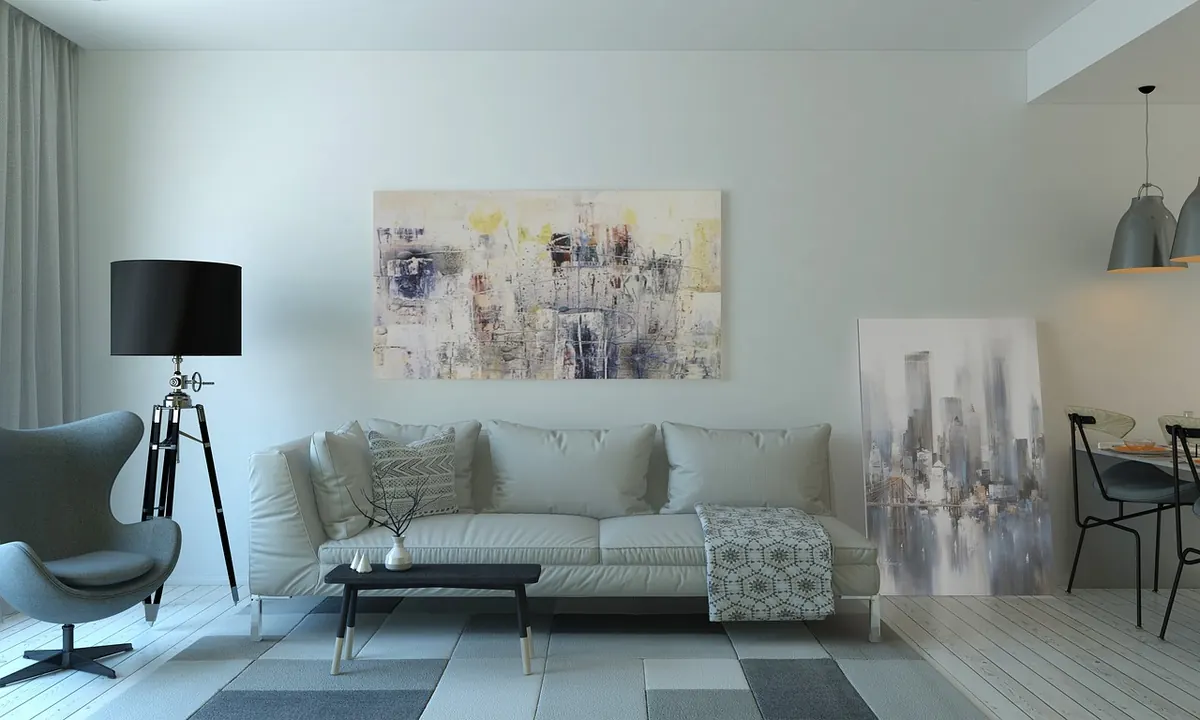
Floor lamps are the most under-used tool in an evening room. One placed in a corner behind a chair, angled towards the wall, bounces light off two surfaces and gives you gentle ambient glow with no visible glare. One beside a sofa at shoulder height does the same job for reading.
Two details matter more than the lamp itself. First, the shade. Linen, paper and opal glass diffuse light beautifully; metal and dark shades push it into a tight beam. Second, the height. When you are seated, the bottom edge of the shade should sit around eye level so you are not looking at the bulb. A shade noticeably wider than its base will spread light further and feel more generous.
Use table lamps as pools of light
Table lamps are where a room starts to feel lived in. Put them on side tables, a console behind the sofa, a windowsill, a hall shelf. The trick is variation: three lamps at different heights across a room read far better than three identical ones at the same height. Different shades are fine — the eye enjoys the variety — as long as the colour of the light stays consistent.
Small inline dimmers and plug-in dimmer sockets are inexpensive and let you tune each lamp separately. That single change, more than any new purchase, is what turns a set of lamps into a lighting scheme.
Add accents last, and keep them low
Accent lighting is the finishing touch, and it should be the dimmest thing in the room. Plug-in wall sconces work well for renters. A slim picture light above a print, a warm strip along the back of a shelf, or a small lamp on a bookshelf all add depth without adding brightness.
Candles belong in this layer too. Keep them on heatproof surfaces, away from curtains, cushions and anything loose, and never leave them burning in a room you have left. The flicker is lovely; the risk is not worth forgetting.
A ten-minute evening set-up
- Turn the ceiling light off, or take it down to its lowest setting.
- Switch on the lamp furthest from where you usually sit. That is your ambient layer.
- Add one lamp close to your seat for reading or chatting — the task layer.
- Add accents last: a shelf light, a picture light, a candle.
- Stand in the doorway and look back. If you can see a bare bulb or a bright patch glaring off a wall, move the lamp or shade it.
Bulbs, brightness and a few practical notes
Colour temperature does more for atmosphere than wattage. Warm white sits around 2700K; anything marked 2200K or "amber" is warmer still and works well for accents. Avoid mixing a cool white bulb with warm ones in the same sightline — the mismatch is what makes a room feel unsettled.
Check that bulbs are marked as dimmable before pairing them with a dimmer, and expect the occasional buzz or flicker with older switches; a dimmer rated for LEDs usually sorts it. Keep brightness fairly even between lamps so no single one dominates, and lower the overall level as the evening goes on. If you are adding new wiring, sockets or wall lights, use a qualified electrician.
Let the room get dark
A warm evening room is not evenly lit. It has bright pools, soft middles and a corner or two left in shadow — that contrast is what makes it feel calm rather than merely dim. So start with fewer lights, place them better, and run them lower than you think you should. If the room still feels harsh, the answer is almost never more light. It is usually a different height, a softer shade, or simply switching something off.
Photo: wal_172619 / Pixabay